
Did you ever see an aircraft and wonder more about it? Well if you did, there’s an easy way to see more info on the aircraft. Your best search will incluse the registration number on the aircraft but it’s not the only way!
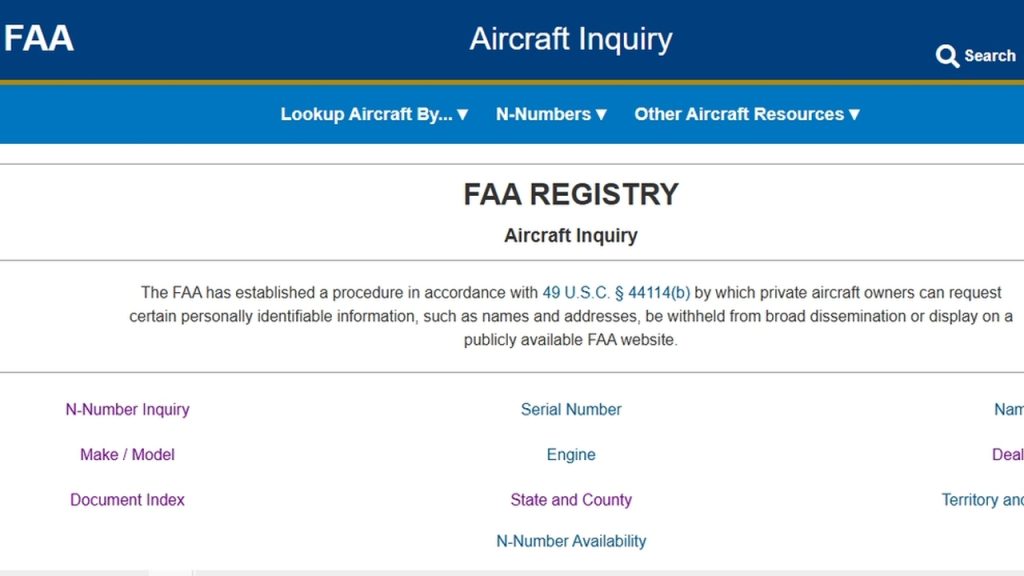
In the U.S. you can search on the FAA site here ….. more
In Canada you can search the Transport Canada site here ….. more

Here’s some of the info you might get!
FAA (United States)The FAA provides aircraft registration information through its Aircraft Registry Database, accessible via the FAA website (https://registry.faa.gov/). Here’s what you might find:
- Aircraft Identification:
- Registration Number (N-Number): The unique identifier (e.g., N12345) assigned to the aircraft.
- Serial Number: The manufacturer’s unique serial number for the aircraft.
- Manufacturer and Model: Details about the aircraft’s make (e.g., Boeing, Cessna) and specific model (e.g., 737-800, 172S).
- Type of Aircraft: Category such as airplane, helicopter, glider, or balloon.
- Ownership Information:
- Registered Owner: Name of the individual, company, or organization that owns the aircraft.
- Owner’s Address: Mailing address of the registered owner (though some privacy restrictions may apply).
- Co-Owner or Trust Details: If applicable, information about co-ownership or trust arrangements.
- Registration Status:
- Status: Whether the registration is active, expired, pending, or revoked.
- Issue and Expiration Dates: When the registration was issued and when it expires (typically valid for three years in the U.S.).
- Type of Registration: Individual, corporation, partnership, government, or other.
- Aircraft Specifications:
- Year of Manufacture: The year the aircraft was built.
- Engine Type: Information about the engine(s), such as manufacturer and model.
- Maximum Takeoff Weight: The aircraft’s certified maximum takeoff weight.
- Number of Seats: Passenger or crew seating capacity.
- Airworthiness:
- Airworthiness Certificate: Details about the aircraft’s airworthiness status (e.g., Standard, Experimental, Restricted).
- Date of Airworthiness: When the certificate was issued.
- Historical Data:
- Previous Owners: Some records may show prior ownership history.
- Changes in Registration: Details about transfers, cancellations, or updates to the registration.
- Additional Documents (if applicable):
- Bill of Sale: Proof of ownership transfer.
- Liens or Encumbrances: Information about any financial or legal claims against the aircraft.
- Deregistration/Export Information: If the aircraft has been exported or removed from the U.S. registry.
Accessing the Data:
- The FAA’s Aircraft Inquiry tool allows searches by N-number, serial number, or owner name.
- Some information is publicly available, but sensitive details (e.g., owner’s personal address) may be restricted for privacy reasons, especially for non-commercial aircraft.
- Additional services, like certified copies of records, may require a fee.
Transport Canada (Canada)Transport Canada maintains the Canadian Civil Aircraft Register (CCAR), accessible through their website (https://wwwapps.tc.gc.ca/Saf-Sec-Sur/2/CCARCS-RIACC/). Here’s the type of information you can expect:
- Aircraft Identification:
- Registration Mark: The unique identifier (e.g., C-FABC or C-GXYZ) assigned to the aircraft.
- Serial Number: The manufacturer’s serial number.
- Manufacturer and Model: The make and model of the aircraft (e.g., Piper PA-28, Airbus A320).
- Aircraft Type: Fixed-wing, rotorcraft, balloon, etc.
- Ownership Information:
- Registered Owner: Name of the individual, corporation, or entity owning the aircraft.
- Owner’s Address: The registered address of the owner (subject to privacy restrictions).
- Operator Information: If different from the owner, details about the entity operating the aircraft.
- Registration Details:
- Registration Status: Active, suspended, canceled, or pending.
- Date of Registration: When the aircraft was registered in Canada.
- Type of Registration: Private, commercial, or state (government-owned).
- Aircraft Specifications:
- Year of Manufacture: The year the aircraft was built.
- Maximum Takeoff Weight: Certified weight limit.
- Engine Details: Type and number of engines.
- Category: General aviation, commercial, or other classifications.
- Airworthiness Information:
- Certificate of Airworthiness (C of A): Indicates whether the aircraft meets safety standards for flight.
- Flight Authority: Details about the type of airworthiness certificate (e.g., Standard, Special).
- Maintenance Records: While not publicly available, the registry may indicate compliance with airworthiness directives.
- Historical Information:
- Previous Registrations: If the aircraft was previously registered in Canada or another country.
- Import/Export Data: Information about whether the aircraft was imported or exported.
- Additional Information:
- Leases or Liens: Details about any legal or financial encumbrances.
- Modifications: Records of major modifications or changes to the aircraft’s configuration.
- Operational Use: Whether the aircraft is used for private, commercial, or other purposes.
Accessing the Data:
- The CCAR allows searches by registration mark, serial number, or owner name.
- Public access is limited to certain fields to protect privacy, especially for private owners.
- Detailed records or certified copies may require a formal request and fees.
Key Differences Between FAA and Transport Canada:
- Privacy: The FAA tends to provide more publicly accessible ownership details, while Transport Canada may restrict certain personal information for privacy reasons.
- Registration Marks: U.S. aircraft use “N” numbers (e.g., N12345), while Canadian aircraft use “C” prefixes (e.g., C-FABC).
- Registration Validity: FAA registrations expire every three years and require renewal, while Transport Canada registrations do not have a set expiration but can be canceled if conditions (e.g., airworthiness) are not met.
- Search Interface: The FAA’s database is more user-friendly for public searches, while Transport Canada’s CCAR may require more specific inputs (e.g., exact registration marks).
General Notes:
- Both databases are primarily for regulatory compliance, safety, and tracking ownership, so the information focuses on legal and technical details rather than operational history (e.g., flight logs).
- For both systems, sensitive information (e.g., detailed maintenance records or private owner contact details) may require authorized access or formal requests.
- If you’re looking for real-time tracking or flight history, these government registries won’t provide that; you’d need to use third-party services like Flightradar24, FlightAware or ADS-B Exchange.
- I’ve been using Flightradar24 and I must say, “It works well”.
Have fun searching aircraft!