Jump to other Aviation Related Links
- See the main page on Air Tankers & Water Bombers right here ….. more
- See the main page on Airports & Base Camps right here ….. more
- See the main page on Aviation Museums right here ….. more
- See the main page on Aviation Training right here ….. more
- See the main page on Bush Planes right here ….. more
- See the main page on Cargo & Transport Aircraft right here ….. more
- See the main page on Helicopters right here ….. more
- See the main page on Military Aircraft right here ….. more
Conair Aviation
I worked for Conair Aviation at the Edmonton, Alberta municipal airport, Callsign (YXD), (No longer operational) on Air Tankers & other Aerial Fire Fighting aircraft. Here’s some photos and related information.
CL-215
CL-215 #290 (C-GBYU, c/n 1083) and #296 (C-GDHN, c/n 1089) were piston-engined Canadair CL-215-1A10 (or CL-215-V) amphibious water bombers.
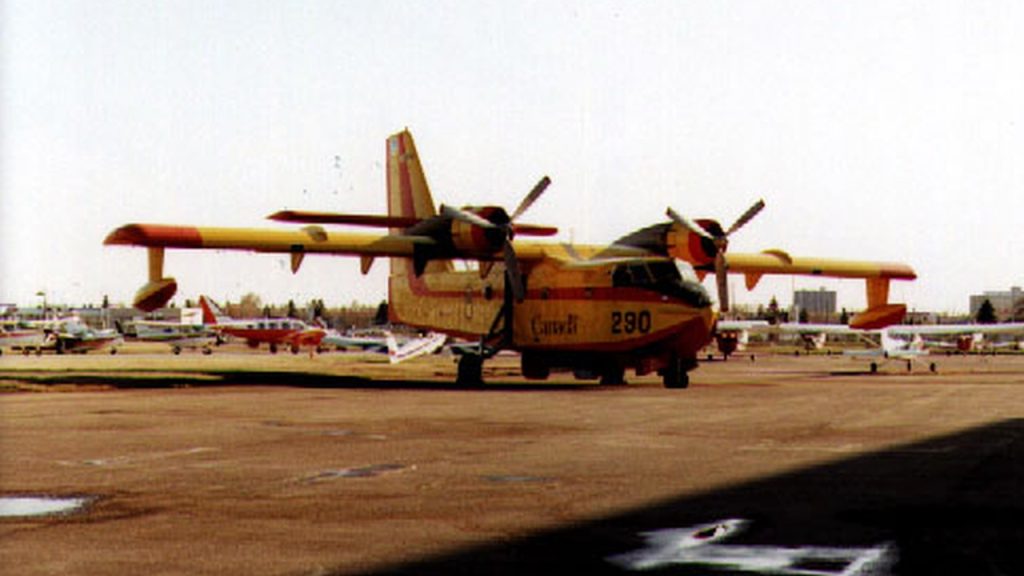
These aircraft were part of Conair Aviation’s operations in the late 1980s/early 1990s, supporting wildfire suppression contracts, including for provincial governments like Alberta and the Northwest Territories.
Background on the Aircraft and Conair’s Role
The Canadair CL-215 (“Scooper”) is a purpose-built twin-engine amphibious flying boat designed for aerial firefighting. It can scoop up to ~1,440 US gallons (5,455 liters) of water in about 10–12 seconds from lakes/rivers while on the step, then drop it on fires. It also carries retardant when loaded on the ground.
We more commonly called them “Ducks”, not “Scoopers”.
Powered by two Pratt & Whitney R-2800 Double Wasp radial piston engines (See Below), these aircraft are rugged, low-speed performers ideal for low-level operations over forests.
Conair (headquartered in Abbotsford, BC) operated and/or maintained CL-215s under contract. They handled heavy maintenance, modifications, and operational support for government-owned or contracted fleets. In the late 1980s/early 1990s, Conair deployed and supported these aircraft across western and northern Canada during fire seasons.
Specifics on #290 and #296
#290 (C-GBYU, c/n 1083): Built in 1985. It flew with Conair Aviation (as Tanker 290) before transitioning to Buffalo Airways. It has a long history in Canadian firefighting, later appearing in operations with Buffalo (e.g., in the Northwest Territories).
#296 (C-GDHN, c/n 1089): Built around 1986. Also operated by Conair (Tanker 296), including on behalf of the Northwest Territories Government. It later went to Buffalo Airways (noted as “Buffalo 296” in photos and shows like Ice Pilots). It was eventually sold onward (e.g., toward Viking Air conversions).
Both were piston-powered CL-215s (R-2800 engines) (See Below)
Edmonton / YXD Connection (1989–1990)
Edmonton Municipal Airport (YXD) served as a key base or maintenance hub for Conair’s CL-215 operations during this period. Conair supported Alberta and northern contracts, with aircraft rotating through Edmonton for maintenance, loading, or staging during fire seasons. Conair’s work at YXD likely involved heavy maintenance, engine overhauls (R-2800 radials), inspections, and winter storage/prep.
Specific public records from exactly 1989–1990 are sparse online, but these tankers fit the timeline of Conair’s CL-215 activity in Alberta/NWT support. YXD’s facilities were suitable for amphibious aircraft maintenance away from their primary Abbotsford base.
Operational Notes
These aircraft excelled at repetitive scooping from remote water sources, delivering water or retardant quickly. They were part of Canada’s pioneering heavy water-bomber fleet before widespread adoption of turboprop/jet types. Conair’s experience with these (and DC-6s) helped transition to modern fleets like CL-215Ts and CL-415s. Many ex-Conair/Buffalo CL-215s remain active or have been upgraded.
If we ever meet you can ask me about: How I accidently drained 25 gallons of engine oil on the hangar floor!
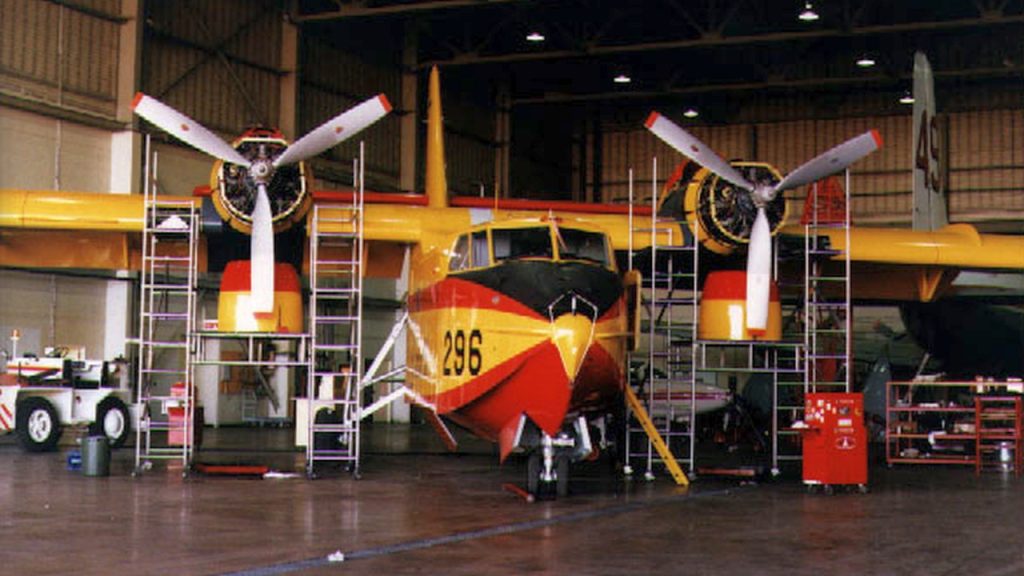
DC6B
C-GHLZ was a Douglas DC-6B converted to an air tanker (Tanker #45) operated by Conair Aviation (now Conair Aerial Firefighting) of Abbotsford, British Columbia.
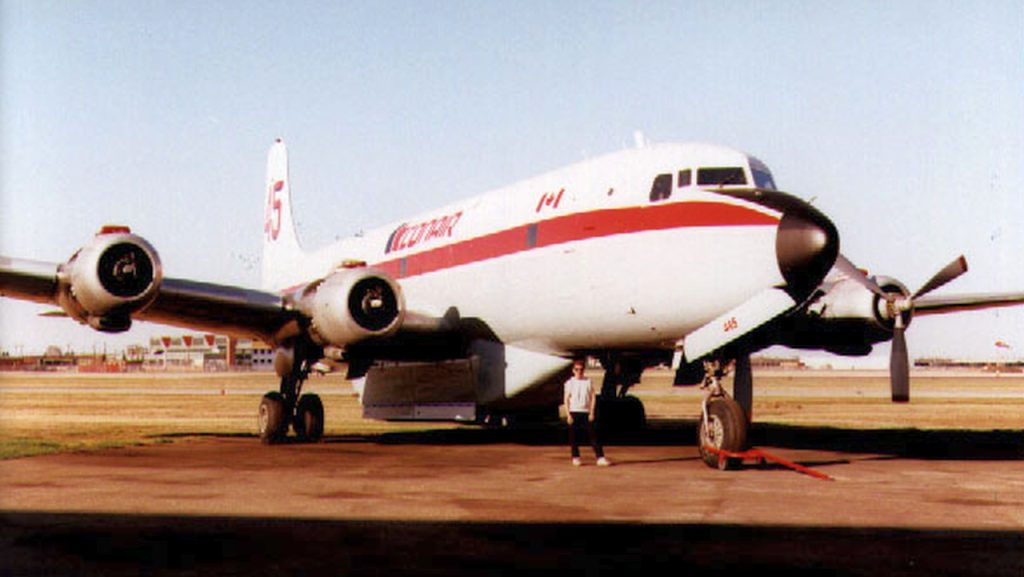
Registration: C-GHLZ
Serial: 45478 / 962
Fleet number: 45
Aircraft Original Type: Douglas DC-6
Aircraft Generic Type: Douglas DC-6 (C-118/R6D/Liftmaster)
Aircraft Version: Douglas DC-6B/AT
Operator Titles: Conair Aviation
Basic History & Construction:
Built in 1958 as a DC-6B. It initially served as a passenger airliner, including operations in Europe (e.g., with operators like Delta Air Transport in Belgium before transfer to Canada).
Conair Conversion and Service:
Acquired by Conair around January 1975 and converted to a firebomber (air tanker) with a retardant tank system. It flew as Tanker #45, primarily for forest fire suppression in Canada (and possibly internationally). It remained with Conair until around 1997–2001.
Conair operated a small fleet of DC-6B tankers in the 1970s–1990s/early 2000s as part of their heavy air tanker operations. These were among the larger fixed-wing tankers of their era before being succeeded by types like Convair CV-580s, Lockheed Electras, and later turboprops/jets.
Engine Types
The DC-6B is powered by four Pratt & Whitney R-2800 Double Wasp radial piston engines (typically the -CB series variants in later models, producing around 2,400–2,500 hp each depending on the specific sub-variant). These were reliable, powerful 18-cylinder radials common to the DC-6 family.
Retardant Capacity
Conair’s DC-6B tankers, including early examples, were configured with tanks holding approximately 2,500–3,000 US gallons (roughly 9,500–11,350 liters) of fire retardant. The company’s first DC-6B (added in 1971) was noted as the first 3,000 US gallon tanker in North America, and others in the fleet followed similar conversions with interiors gutted for maximum tank capacity.
Exact capacity could vary slightly by specific aircraft configuration, load, and mission profile, but they were classified as large (Type 1) air tankers capable of delivering significant volumes in single or multi-drop passes.
Conair Operations in Edmonton, AlbertaConair (headquartered in Abbotsford, BC) has long supported wildfire suppression across western Canada, including Alberta, under contracts with provincial governments. They deploy aircraft to bases across Alberta (e.g., High Level, Whitecourt, and others among the province’s ~13 air tanker bases) on a rotational or as-needed basis during fire season.
Conair’s DC-6 fleet was active in Canadian firefighting during the 1970s–1990s, including in Alberta and BC. Today, Conair continues to base/rotate modern tankers (Dash 8-400AT, RJ85, etc.) in Alberta for provincial wildfire management.
Conair’s DC-6 era represented pioneering heavy tanker work in Canada, evolving from smaller aircraft to these four-engine piston types for longer range and higher capacity drops. The aircraft were later retired from firefighting as newer, more efficient turboprops and jets took over.
If we ever meet you can ask me about: How the entire fleet of DC6’s was grounded just before the fire fighting season began due to something I found while inspecting air tanker #45!
R-2800 Double Wasp Engines

The Pratt & Whitney R-2800 Double Wasp is a legendary American 18-cylinder, twin-row, air-cooled radial aircraft engine with a displacement of 2,800 cubic inches (about 46 liters). It is part of Pratt & Whitney’s long-running Wasp family and is widely regarded as one of the finest and most reliable piston radial engines ever built.
Key Specifications (Typical for Many Variants)Configuration: 18 cylinders in two rows of nine, air-cooled radial.
Bore x Stroke: 5.75 in (146 mm) x 6 in (152 mm).
Dry Weight: Around 2,300–2,400 lb (1,043–1,090 kg), depending on the variant (e.g., the CB16 commercial version weighed about 2,350 lb / 1,068 kg).
Dimensions: Diameter ~52.8 in (134 cm), length ~81.4 in (207 cm).
Power Output: Production models typically delivered 2,000–2,500 hp (1,491–1,865 kW) at takeoff, with ratings around 2,100 hp at 2,700 rpm common in mid-war versions. Some experimental or water-injected variants reached 2,800 hp or more on test stands (up to ~3,000+ hp in extreme racing/boosted setups).
Supercharging: Varied by version—single-stage, two-stage, variable-speed, or turbo-supercharged.
Fuel: High-octane aviation gasoline (often 100/130 grade; later 115-grade with water injection for extra power).
Cooling: Innovative machined cooling fins (cut from solid forgings with very fine, thin pitch) plus advanced baffling for efficient airflow, addressing the heat challenges of its high power density.
History and Development
The R-2800 first ran in 1937 and flew in 1940. It was America’s first 18-cylinder radial and entered production in 1939. When introduced, it produced 2,000 hp—exceptional specific power for an air-cooled engine at the time (~0.71 hp per cubic inch initially).
Over 125,000 units were built from 1939 to 1960. Wartime demands drove rapid improvements (higher boost, water/methanol injection for takeoff and emergency power). Post-WWII, the focus shifted to reliability for commercial and cargo use, where it excelled with long overhaul intervals.
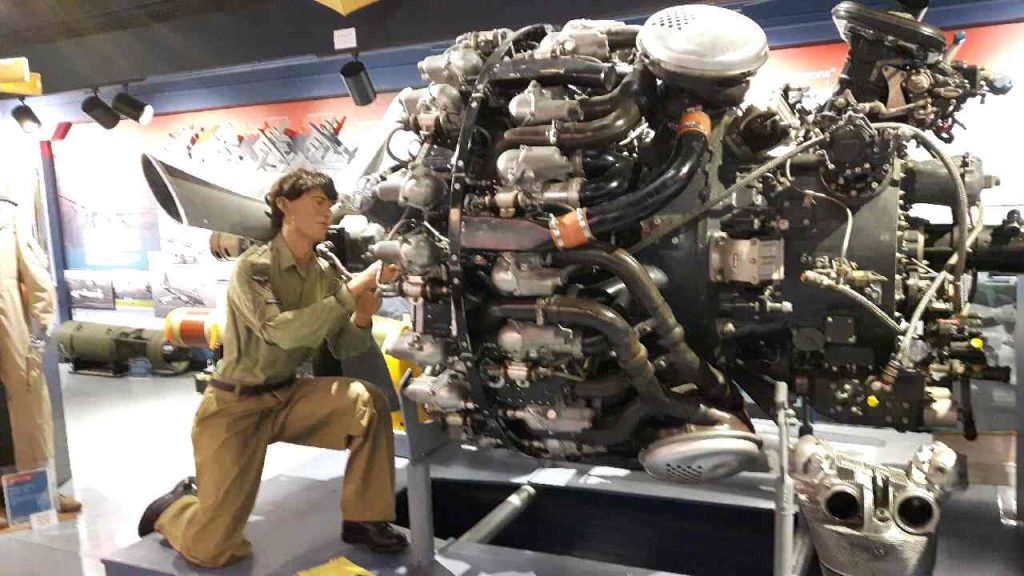

Major Applications
WWII Fighters: Republic P-47 Thunderbolt, Vought F4U Corsair, Grumman F6F Hellcat (key to Pacific air superiority).
Bombers/Attack: Douglas A-26 Invader, Martin B-26 Marauder.
Post-War Transports: Douglas DC-6 (including Conair’s air tankers like C-GHLZ), Convair 240/340/440 series, Martin 404.
Others: Various cargo, patrol, and even some water bombers (e.g., Canadair CL-215 in certain configs). Ex-DC-6s still fly today with R-2800s in cargo roles, notably in Alaska.
The DC-6B typically used later commercial variants such as the R-2800-CB16 or similar (rated around 2,400 hp at 2,800 rpm, with options up to 2,500 hp). These provided the power, reliability, and endurance needed for long-range firefighting missions with heavy retardant loads. The engines’ ruggedness suited the demanding low-level drop profiles, rough-field operations, and repeated cycles in wildfire seasons.
Strengths and Legacy
Reliability & Durability: Extremely tough; many examples continue flying decades later.
Power-to-Weight & Compactness: Allowed tight cowlings and good performance.
Innovations: Advanced cooling, dual ignition/magnetos, and flexible supercharging options.
Drawbacks (common to radials): High fuel consumption compared to modern turboprops, significant maintenance for piston engines, and noise/vibration.
The R-2800 helped win WWII in the air and powered the transition to reliable post-war commercial aviation. Its reputation for being “bulletproof” when properly maintained is well-earned. Some restored warbirds and operational DC-6s keep these engines active today.
Bird Dogs
I also worked on 2 different Bird Dogs while at Conair in Edmonton, Alberta.
Cessna 337
Cessna 337 Skymaster (often O-2 variant) as Bird Dogs in Firefighting
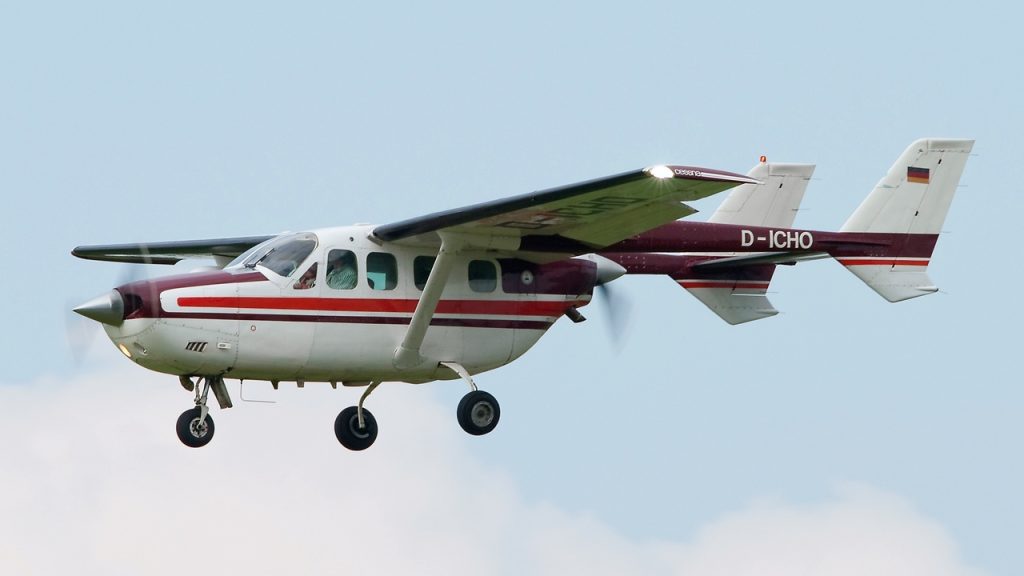
The above is a random file photo from Wikipedia.
The Cessna 337 Super Skymaster, with its distinctive push-pull twin-engine configuration (one propeller pulling in front, one pushing in back), has served effectively as a “bird dog” or lead/spotter aircraft in aerial firefighting. Its centerline thrust design provides good handling even with an engine out, making it stable for low-level observation and coordination over fires. Military O-2 versions, originally used for forward air control in Vietnam, were adapted for civilian firefighting roles.
- Key advantages: High-wing for excellent downward visibility, twin-engine reliability/safety, good loiter capability, and room for a pilot plus Air Attack Officer.
- Usage examples: CalFire (California) operated them as tactical aircraft from 1976 into the mid-1990s; used by agencies in Canada (e.g., Ontario) and Australia (e.g., NAFC call signs like Birddog 372/380); equipped for spotting, leading tankers to drop zones, airspace coordination, and fire assessment.
- Often replaced by faster or more modern platforms like OV-10 Broncos in some fleets.
Piper Aerostar
Piper Aerostar as Bird Dogs in Firefighting
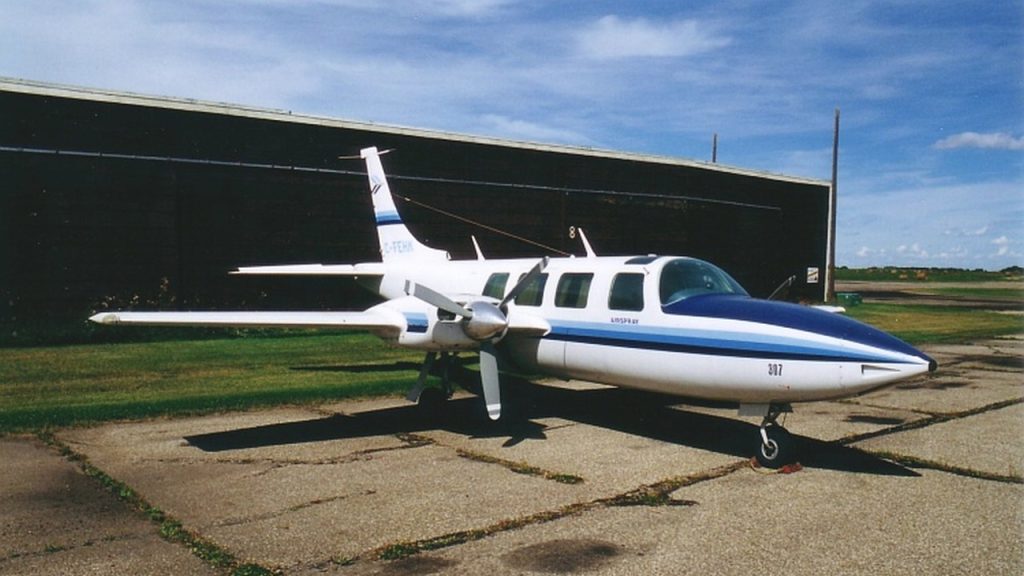
The above is a random file photo from Wikipedia.
The Piper Aerostar is a sleek, twin-engine piston (or turbo) light aircraft valued for its speed and performance as a bird dog/lead plane. Operators like Conair Group in Canada have used it alongside air tankers (e.g., Convair 580s) for wildfire suppression.
- Key advantages: Relatively fast for a light twin, good climb performance, and suitable for carrying a pilot and Air Attack Officer; equipped for coordination, FLIR in some cases, and directing drops.
- Usage examples: Employed by Canadian operators (e.g., Conair and Air Spray) for air attack roles—assessing fires, guiding tankers to safe drop runs, and managing airspace; listed among common bird dog types alongside Cessna models.
- Many have been superseded by turboprops like Aero Commanders or Caravans in modern fleets.
Jump to other Aviation Related Links
- See the main page on Air Tankers & Water Bombers right here ….. more
- See the main page on Airports & Base Camps right here ….. more
- See the main page on Aviation Museums right here ….. more
- See the main page on Aviation Training right here ….. more
- See the main page on Bush Planes right here ….. more
- See the main page on Cargo & Transport Aircraft right here ….. more
- See the main page on Helicopters right here ….. more
- See the main page on Military Aircraft right here ….. more
Have a great day everyone!