
The Sikorsky S-64 Skycrane (also known as the Aircrane in its modern Erickson form) is a specialized twin-engine heavy-lift helicopter with a skeletal “flying crane” design optimized for external loads rather than internal cabin space. It is the civilian counterpart to the U.S. Army’s CH-54 Tarhe.
Brief History and Development
Sikorsky developed the S-64 as an enlarged turbine-powered evolution of its earlier piston-engined S-60 flying crane prototype. The goal was a dedicated heavy-lift platform for both military and civil use, emphasizing external payload capacity with a minimalist fuselage boom, adjustable landing gear, and powerful engines. The prototype first flew on May 9, 1962.
- The U.S. Army evaluated early examples and ordered it as the CH-54 Tarhe (named after a Native American tribe), which entered service in the mid-1960s. It saw extensive use in Vietnam for recovering downed aircraft, transporting heavy equipment, artillery movement, and even troop/pod transport.
- Civilian development followed: the S-64E (based on the CH-54A) received FAA certification in 1969. A more powerful S-64F (derived from the CH-54B) followed. Production was limited (around 100 total military + civil examples built by Sikorsky).
- In 1992, Erickson Air-Crane acquired the type certificate and manufacturing/support rights from Sikorsky. The company has since operated, upgraded, and converted many ex-military airframes, focusing on firefighting, logging, construction, and heavy utility roles. Many S-64s remain active today, often with modern modifications like firefighting tanks.
Key model names:
- Civilian: S-64E, S-64F (and Erickson-upgraded Aircrane variants, sometimes referred to as S-64 Aircrane).
- Military: CH-54A Tarhe (base model), CH-54B (uprated engines and higher capacity).
Common Specifications (primarily S-64E/F Aircrane; varies by variant and configuration)
- Crew: 2 pilots (pilot + co-pilot); often includes a third crew member (aft-facing loadmaster/operator) for external load operations.
- Capacity: Minimal internal (up to 5 people total in some configs, often just crew); no large passenger cabin—optimized for external loads. Can carry specialized pods (e.g., for troops or cargo in military use).
- Sling/external load capability: Up to 20,000 lb (9,072 kg) standard on S-64E; up to 25,000 lb (11,340 kg) on S-64F/stronger variants. Excellent precision hovering and load-handling with a main cargo hook (and auxiliary hoists).
- Powerplant: 2 × Pratt & Whitney JFTD12 (T73) turboshafts (e.g., ~4,050–4,800 shp each depending on variant).
- Performance (approximate): Max speed ~109–115 kts; cruise ~105 kts; range ~200–230+ nmi (with reserves); service ceiling ~9,000–13,000+ ft (good hot/high capability for its size); hover ceiling IGE ~10,600 ft.
- Weights: Max gross ~38,000–42,000+ lb; empty ~19,000–20,000 lb range.
Specs vary with altitude, temperature, fuel, and mission equipment (e.g., 2,650-gallon firefighting tank).Specific Differences Between the S-64 (Civilian) and Military Version (CH-54 Tarhe)The S-64 is the direct commercial derivative of the CH-54, sharing the core airframe, rotors, and engines.
- Certification and Build: Civilian S-64 models hold FAA type certification for commercial operations. Military CH-54s were built to mil-specs and often require conversion for civil use.
- Equipment/Features: Civilian versions emphasize utility optimizations like firefighting tanks (e.g., 2,650 gal snorkel system), logging grapples, civil avionics, and load-handling gear. Military versions included mission-specific items (e.g., pod attachments for troops/equipment, recovery gear) and potentially more rugged combat features.
- Performance: The CH-54B and S-64F are uprated (stronger engines, higher payload, dual main wheels on some). Civilian operators often add mission kits (e.g., water tanks) that affect weights and performance.
- Use: Military focused on battlefield heavy lift, aircraft recovery, and Vietnam-era logistics. Civilian excels in firefighting (initial attack and water drops), logging (precision extraction), construction (e.g., towers, bridges), and disaster relief.
Many current civilian S-64s are converted ex-military airframes.
Additional Interesting Facts
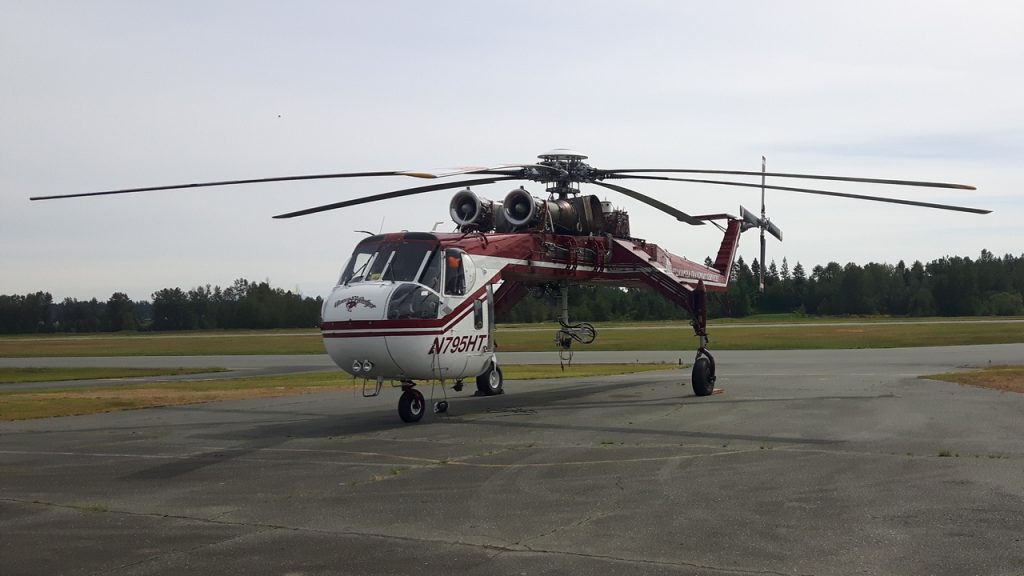
- Unique Design: The open “skeletal” fuselage with high-clearance landing gear allows it to straddle and precisely place large or awkward loads (e.g., shipping containers, vehicles, or even other helicopters). An aft-facing pilot station aids in load monitoring.
- Firefighting Legend: Equipped with a large belly tank and snorkel, it can scoop water from lakes/rivers while hovering and deliver it rapidly—highly effective for wildfire suppression.
- Record Holder: A variant set a world altitude record for helicopters in level flight (over 36,000 ft in some reports).
- Longevity: Despite limited production numbers, the type has proven exceptionally durable. Erickson continues upgrades (e.g., composite blades) to keep the fleet viable.
- Versatility: Has lifted everything from massive logs and construction materials to statues, antennas, and even houses in specialized ops.
The S-64 Skycrane/Aircrane is a true heavy-lift specialist—unmistakable in appearance and unmatched in its ability to handle oversized external loads in challenging environments. Its design remains relevant decades later for demanding civilian missions.
I spotted this Sikorsky S64 at the Nanaimo Regional Airport, on Vancouver Island, BC, Canada. It was posted to “Fire Fighting” for the summer.