
The MBB Bo 105 (often referred to as MBB 105) is a pioneering light, twin-engine, multi-purpose helicopter developed in West Germany. It was the world’s first light twin-turbine helicopter and featured a revolutionary hingeless (rigid) rotor system with composite blades, offering exceptional agility, including full aerobatic capability (loops and rolls).
Brief History and Development
Development began in the early 1960s by Bölkow (later merged into Messerschmitt-Bölkow-Blohm — MBB). The design emphasized a hingeless rotor system (developed with input from Sud-Aviation), twin-engine safety, and versatility for both civil and military roles. The second prototype first flew on February 16, 1967.
- German LBA certification came in 1970, with FAA certification in 1971. Production started in the early 1970s and continued until 2001, with over 1,600 built (including licensed production, e.g., by CASA in Spain).
- It saw widespread civil use (EMS, police, utility, passenger transport) and military adoption (observation, liaison, anti-tank). It was later succeeded/influenced designs like the BK 117 and EC 135. Many remain in service today.
Key model names:
- Civilian: Bo 105A (initial), Bo 105C/CB/CBS (improved), Bo 105S (stretched), Bo 105LS (Lift Stretch — higher performance).
- Military/export: Bo 105M (VBH — liaison/observation), Bo 105P/PAH-1 (anti-tank with HOT missiles), plus variants for reconnaissance, training, and maritime roles. Licensed/export versions used by many forces.
Common Specifications (primarily Bo 105CB/CBS; varies by variant)
- Crew: 1–2 pilots.
- Capacity: 3–4 passengers (or 1 pilot + 4 in high-density); medevac configs with 2 stretchers + attendants.
- Sling/external load capability: Up to ~1,200–2,000+ kg (2,645–4,400+ lb) depending on variant and conditions (good for its light class, used in utility roles).
- Powerplant: 2 × Allison 250-C18/C20 series turboshafts (typically 300–420 shp each class).
- Performance (approximate): Max speed ~135–150 kts (250+ km/h); cruise ~120+ kts; range ~300–400+ nmi (550–657 km); service ceiling ~16,000–17,000+ ft; excellent hover and hot/high performance for its era.
- Weights: Max gross ~2,100–2,500+ kg (4,630–5,510+ lb); empty ~1,200–1,500 kg range. ntps.edu
Specs vary with specific model, modifications, altitude, and temperature.Specific Differences Between the Bo 105 (Civilian) and Military VersionsThe core airframe, rotor system, and engines are highly similar, with military variants adapted for mission needs.
- Equipment/Armament: Military versions (e.g., PAH-1) add weapon pylons for anti-tank missiles (HOT/TOW), sights, and sometimes armor or sensors. Civilian models focus on passenger interiors, EMS kits, or utility hooks.
- Configuration: Military often includes tactical avionics, troop/utility seating, or specialized gear (e.g., mast-mounted sights on some scouts). Some have reinforced transmissions for higher loads.
- Performance: Military variants (e.g., uprated P/PAH models) sometimes feature higher gross weights or strengthened components. Civilian versions optimize for comfort, noise reduction, and commercial certification.
- Certification and Use: Civilian Bo 105s hold civil type certification (LBA/FAA); military models follow mil-specs. Many ex-military airframes have been converted for civil use.
Additional Interesting Facts
- Agility Pioneer: One of the few helicopters certified for full aerobatics, thanks to its hingeless rotor — a major innovation at the time. facebook.com
- Twin-Engine Safety: As an early light twin, it offered better redundancy and performance than single-engine contemporaries, boosting its appeal for EMS, police, and over-water work.
- Global Reach: Operated in dozens of countries for both civil (e.g., disaster response, law enforcement) and military roles; licensed production expanded its footprint.
- Legacy: Its design influenced later Eurocopter (Airbus) models. The hingeless rotor and composite blades reduced maintenance while improving handling. welt-der-hubschrauber.jimdofree.com
The MBB Bo 105 is remembered as a groundbreaking, nimble, and versatile light twin that set new standards for performance and multi-role capability in the 1970s–2000s.
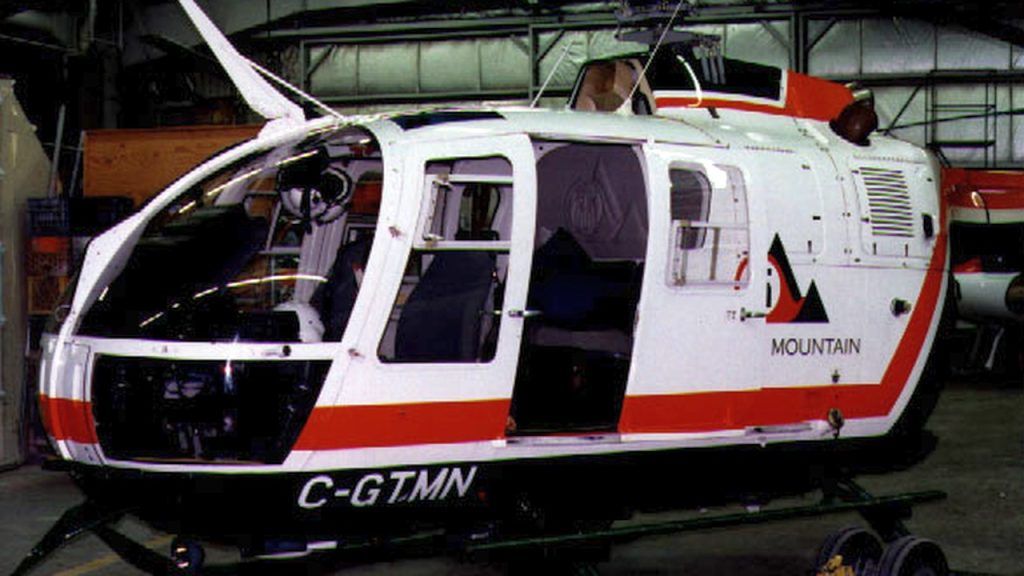
This one stopped by the hangar in Edmonton, Alberta, Canada for some light maintenance and it was gone the next day.