
The Douglas DC-4 (military designation primarily C-54 Skymaster) is a four-engine, low-wing, propeller-driven airliner and transport aircraft with retractable tricycle landing gear. Note: It is not a twin-engine model (the user query likely contains a minor mix-up with the DC-3). It was a major step up in capacity and range from the DC-3.
Brief History of Development and UseDouglas developed the DC-4 in the late 1930s as a larger, longer-range successor to the DC-3, initially responding to requests from United and other airlines. An early pressurized DC-4E prototype (with triple vertical tail) flew in 1938 but proved too complex. Douglas redesigned a simpler, unpressurized version with a single fin and Pratt & Whitney radial engines. The production DC-4 first flew in 1942.
World War II interrupted civilian plans, and nearly all early production went to the military as the C-54/R5D. It became a vital long-range transport, used for troop/cargo movement, VIP flights (including by President Roosevelt), and the Berlin Airlift. Post-war, surplus C-54s were converted for civilian use, serving airlines on transatlantic and long-haul routes into the 1950s–1960s. A total of about 80 civilian DC-4s and over 1,160 military variants were built. Many later served as freighters; a few still fly today in niche cargo roles.
Common Specifications (Typical DC-4/C-54)
- Crew: 4 (pilot, co-pilot, flight engineer, radio operator/navigator).
- Capacity: 40–86 passengers depending on configuration (typically 44–60 in civil airliner setup); up to ~6–7 tons of cargo with large doors and reinforced floor.
- Dimensions: Length ~93–94 ft 10 in (28.6–29 m); wingspan ~117 ft 6 in (35.8 m); height ~27–28 ft.
- Weights: Empty ~38,000–45,000 lb; max takeoff ~73,000 lb (33,100 kg).
- Powerplant: Four radial piston engines (details below).
- Performance: Cruise ~200–227 mph; max speed ~280 mph; range ~2,000–3,700+ miles (varies with load/fuel); service ceiling ~22,000–24,000 ft. Good for its era but required longer runways than smaller bush types.
Radial Engines
- Radial Engines: Powered by four Pratt & Whitney R-2000 Twin Wasp 14-cylinder, twin-row air-cooled radials, each producing 1,450 hp (1,080 kW) for takeoff (1,100 hp continuous). These reliable engines drove three-bladed constant-speed propellers and were known for durability in long-haul operations.
Use as a Cargo Plane by Buffalo Airways
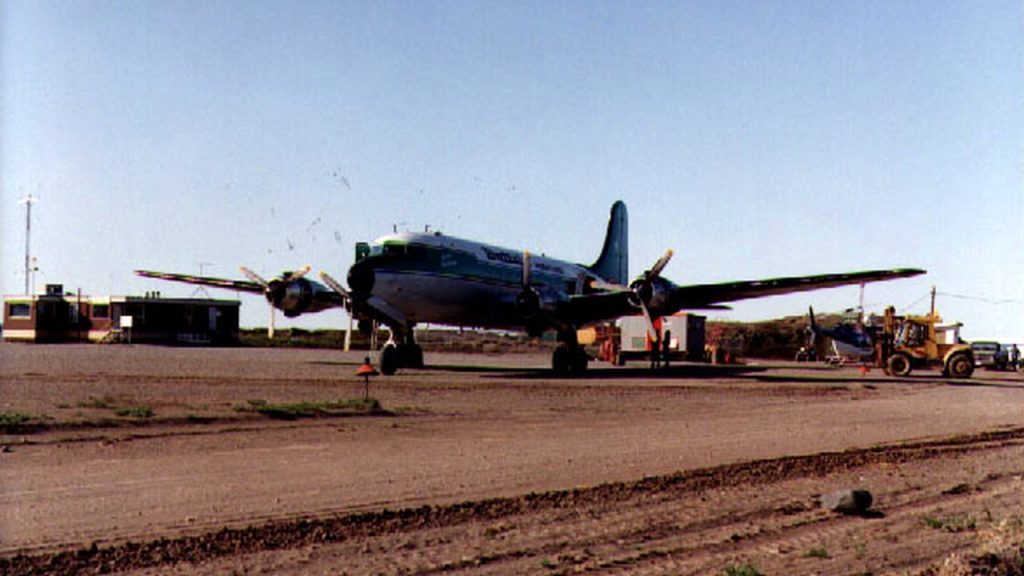
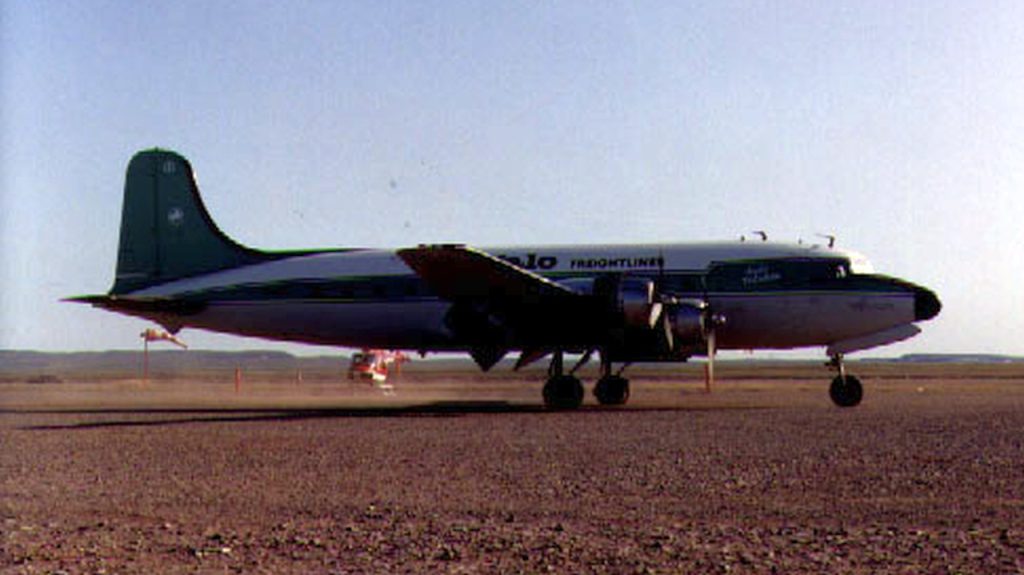
Buffalo Airways (based in Yellowknife, Northwest Territories, Canada) famously operates vintage aircraft for cargo and passenger services in the remote Arctic. They have used the Douglas C-54/DC-4 as a heavy cargo hauler, prized for its large payload, robust construction, and ability to operate into northern gravel/dirt strips. It hauls freight (including fuel, equipment, and supplies) to remote communities and mining operations where modern jets or smaller planes are less practical. The aircraft appears in the TV series Ice Pilots NWT, showcasing its role in harsh northern conditions.
The larger DC-4 is typically restricted to wheeled operations on prepared or gravel surfaces.
Additional Interesting Facts
- Berlin Airlift hero: Hundreds of C-54s formed the backbone of the 1948–1949 operation, delivering vital supplies to West Berlin.
- Presidential aircraft: One modified C-54 (the Sacred Cow) was the first “Air Force One,” used by President Truman.
- Longevity: Some airframes have served over 70–80 years; a handful remain active as freighters or in preservation.
- Carvair conversion: Some were modified by Aviation Traders (ATL-98 Carvair) with a large nose door for car/passenger ferry service (most famously in the UK and Australia).
- Rugged reputation: Known for flying through rough weather and handling heavy loads, though maintenance of the four radials is costly today.
The DC-4 was a pioneering long-range transport that bridged the gap between the DC-3 era and the jet age, playing key roles in war, peace, and remote cargo ops like those of Buffalo Airways.