
The Boeing 707 is a narrow-body, four-engine jet airliner that ushered in the commercial Jet Age. It featured a swept-wing design and podded engines, setting the template for nearly all subsequent jet airliners.
Brief History of Development and Use
Boeing developed the 707 from the 367-80 (“Dash 80”) prototype, which first flew in 1954 as a proof-of-concept for both military tankers and commercial jets. The production 707-120 prototype flew on December 20, 1957. Pan American World Airways (Pan Am) introduced it into commercial service on October 26, 1958, on the New York–Paris route.
It remained in production until 1978 (with some variants until 1991), with 865 built (plus Boeing 720 derivatives). The 707 revolutionized air travel by offering greater speed (around twice that of piston airliners), smoother high-altitude flight, and increased capacity and range. It dominated long-haul routes in the 1960s–1970s before being largely replaced by wide-bodies like the 747, DC-10, and L-1011. Many later served as freighters.

Military History in the Canadian Air Force
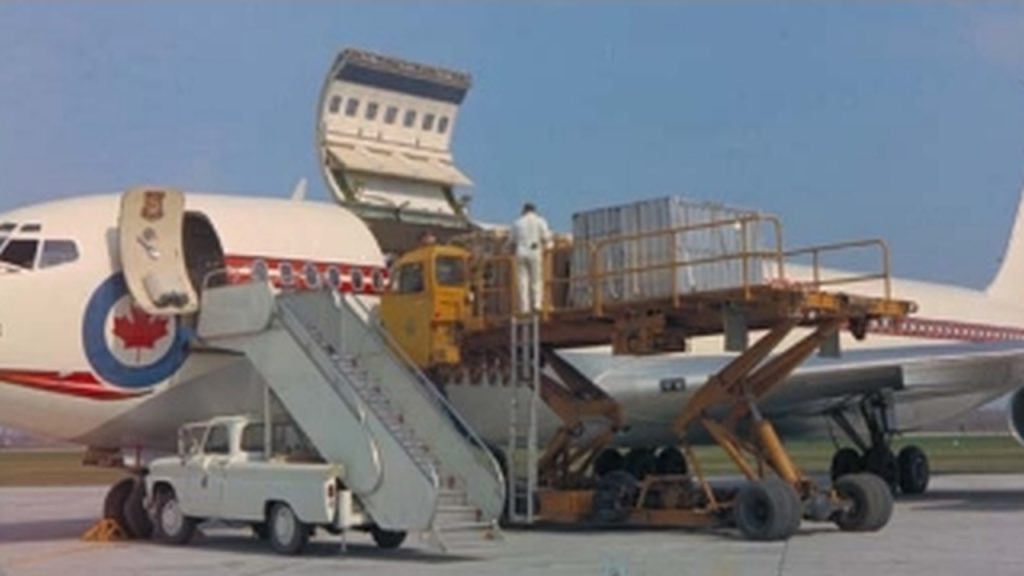
Canada operated five Boeing 707-347C aircraft as the CC-137 from 1970 to 1997, primarily to replace older piston and turboprop transports (CC-106 Yukons). They served with 437 Transport Squadron for long-range passenger/cargo transport, VIP/government flights, and air-to-air refueling of CF-116 (Voodoo) and later CF-18 Hornet fighters.
The CC-137s supported transatlantic and trans-Canada operations, NATO commitments, and humanitarian missions. Two aircraft were equipped as tankers with a boom and drogue systems. The fleet accumulated significant flight hours before retirement in 1997 (transport role ended earlier in 1995), replaced by the Airbus CC-150 Polaris.
Common Specifications (Typical 707-320B/C Intercontinental)
- Crew: 3–4 (two pilots, flight engineer, optional navigator).
- Capacity: 140–189 passengers in mixed class (up to ~219 in high-density configuration); freighter versions carried significant cargo.
- Dimensions: Length ~152–156 ft (depending on variant); wingspan ~142–146 ft.
- Weights: Max takeoff weight ~300,000–328,000+ lb.
- Powerplant: Four turbofan or turbojet engines (details below).
- Performance: Cruise speed ~ Mach 0.80–0.85 (around 480–525 knots); range up to ~3,000–5,000+ nautical miles (varies by variant, load, and fuel); service ceiling ~35,000–42,000 ft.
Civilian Use in Canada & Abroad
In Canada, airlines like Wardair operated 707s for charter and scheduled long-haul flights. They supported inclusive tour charters and transatlantic routes. Abroad, the 707 was a global workhorse for carriers like Pan Am, BOAC, Qantas, Lufthansa, Air France, and many others. It enabled affordable long-distance travel and opened new international routes. Later in life, many converted to freighters served cargo operators worldwide, including in developing markets, until the early 2010s.
Engines
The 707 used four podded engines under the wings:
- Early models (e.g., 707-120): Pratt & Whitney JT3C turbojets.
- Most common later variants: Pratt & Whitney JT3D turbofans (17,000–19,000 lbf thrust each), which offered better efficiency, lower noise, and improved performance.
- Some international variants used Rolls-Royce Conway turbofans.
The shift to turbofans was a major improvement in fuel economy and passenger comfort.
Additional Interesting Facts
- Jet Age pioneer: It halved transatlantic flight times compared to piston airliners and flew above much of the weather.
- Military derivatives: Basis for the KC-135 Stratotanker, E-3 Sentry AWACS, E-6 Mercury, and others.
- Famous flights: Included early presidential use (though not as Air Force One primarily) and record-setting long-range operations.
- Enduring legacy: Many 707s flew for 40–50+ years; its design influenced the entire modern jetliner industry.
- Distinctive sound: Early turbojet versions had a characteristic high-pitched whine and smoke on takeoff.
The Boeing 707 fundamentally changed global travel, commerce, and military logistics, marking the true beginning of the jet age.