
The Bell 204 (and related 205) are the civilian versions of the iconic UH-1 Iroquois (“Huey”) single-engine military helicopter.

The yellow one above is a Bell CH-118 Iroquois used by Canadian Air Force Search & Rescue, it’s basically a stretched 204B which makes it a closer copy of the commercial 205, note the extra window on the side.
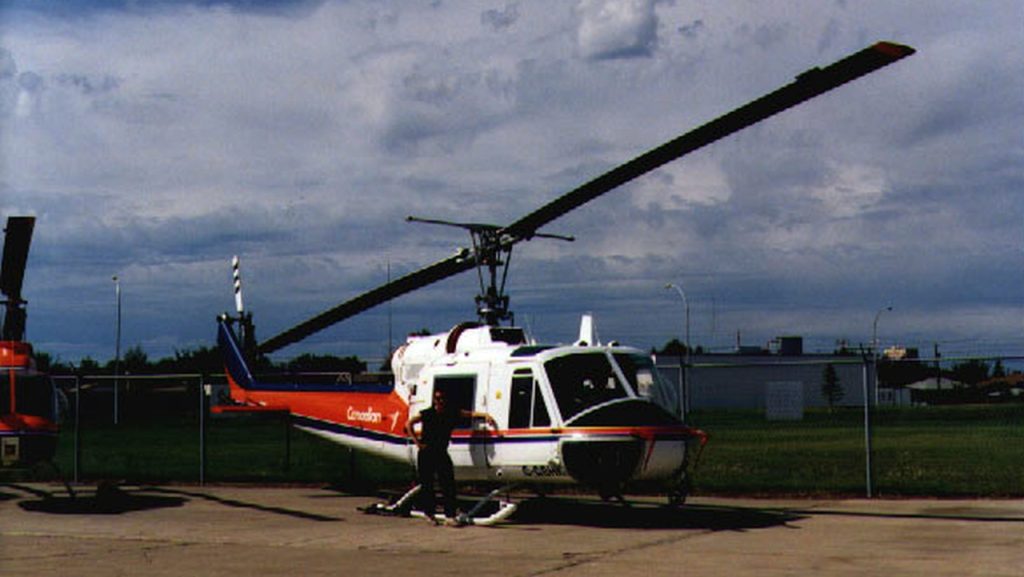
This one is an actual Commercial 204B that was in Edmonton, Alberta while I was there.
Brief History and Development
Bell designed the Model 204 in response to a 1955 U.S. Army requirement for a utility helicopter for medevac, general transport, and training. It represented a major advance as one of the first production helicopters powered by a turboshaft engine (Lycoming T53 series), which offered better power-to-weight ratio, lower fuel consumption, and easier maintenance than piston engines.
- The prototype XH-40 first flew on October 22, 1956. After testing, it entered U.S. Army service in 1959 as the UH-1A Iroquois (nicknamed “Huey” from the original HU-1 designation). aviastar.org
- The Model 204B (civilian/military export version, based on the UH-1B) was certified by the FAA in 1963 and first delivered in 1961. It saw use in civil roles and was licensed-built by Agusta in Italy (Agusta-Bell 204B) from 1961–1973/74, with ~243 produced, many for European militaries.
- The Model 205 (based on the longer-cabin UH-1H/D) followed as a stretched, higher-capacity civilian version with improved performance. Production of 204/205 variants continued into the 1980s.
- These helicopters proved highly successful commercially and militarily, evolving into twin-engine models like the Bell 212 and 214. They remain in service worldwide for utility, firefighting, logging, construction, and more.
Key model names:
- Civilian: Bell 204B, Bell 205A/A-1.
- Military/export: UH-1A/B/C (early short-cabin), UH-1D/H (long-cabin, corresponding more to 205), plus specialized variants (e.g., UH-1E for Marines, UH-1F for USAF). Agusta-Bell 204B.
Common Specifications (primarily Bell 204B; varies by variant/sub-model)
- Crew: 1–2 pilots.
- Capacity: 8–10 passengers (or equivalent cargo); often listed as up to 9–10 total including crew in standard config. The 205A-1 offers more (up to 14 passengers).
- Sling/external load capability: Typically 1,400–1,818 kg (3,000–4,000+ lb) depending on conditions and config; excellent for construction, logging, firefighting (e.g., water buckets or tanks).
- Powerplant: Lycoming T53 turboshaft (e.g., T53-L-09A or T5311A, around 1,100 shp class).
- Performance (approximate for 204B): Max speed ~120–140 mph (220 km/h); cruise ~110–128 mph (200+ km/h); range ~250–300+ nmi (460–560 km); service ceiling ~19,000+ ft.
- Dimensions: Length ~41 ft 8 in (12.7 m); rotor diameter typically 44–48 ft range depending on variant.
- Weights: Max gross ~8,500 lb (3,855 kg) for early 204B; useful load supports substantial cargo/passengers.
Specs vary with configuration, altitude, temperature, and modifications (e.g., firefighting tanks).
Differences Between the Bell 204 (Civilian) and Military Huey (UH-1)The 204/205 are essentially commercial adaptations of the UH-1B and UH-1H, respectively.
- Certification and Build: Civilian 204/205 models are FAA type-certificated for civil operations. Military UH-1s were built to military specs (often not directly FAA-certificated without conversion).
- Cabin: Early 204 (like UH-1B) has a shorter cabin; 205 (like UH-1H) features the stretched “long cabin” for more passengers/cargo.
- Equipment/Features: Civilian versions often include civil avionics, baggage compartments (e.g., in tailboom on 204B), and optimizations for utility roles like slung loads or firefighting. Military versions had specialized gear (armor, weapons pylons, troop seats, etc.) and different engine/protection configs for combat.
- Engines and Performance: Similar Lycoming T53 engines, but variants differed in exact power ratings and modifications. Military Hueys saw extensive combat upgrades (e.g., gunship configs).
- Use: Military focused on troop transport, medevac, and armed roles (especially Vietnam); civilian on transport, lifting, firefighting, etc.
Many ex-military UH-1s have been converted for civil use.
Additional Interesting Facts
- Turboshaft Pioneer: The 204 helped popularize turbine power in helicopters, making them far more practical and influencing the entire industry.
- Vietnam Icon: The military Huey became synonymous with the war, with thousands deployed for nearly every mission type. Its sound and silhouette are culturally iconic.
- Versatility: Civilian 204/205s excel in demanding roles like aerial firefighting (buckets/tanks), logging (slinging logs), construction lifts, mining support, and search/rescue. They are valued for reliability, ease of maintenance, and hot/high performance.
- Longevity: Thousands built; many still flying decades later. Licensed production and exports spread them globally.
- Evolution: Directly led to successful twins (212/412) and other variants still in production or widespread use today.
This helicopter family revolutionized rotorcraft utility and remains a benchmark for rugged, dependable medium-lift performance.
Huey!
Now, go watch “Apocalypse Now”!